|
|

|
|
|||
|
We
must tackle crime together |
|||
|
|
What is needed is a combined operation, and in 1997 we saw significant advances towards a more coherent and focused approach. I particularly welcome the initiatives being taken by local authorities, at county, district and parish council levels. The recently-published Crime and Disorder Bill, as it emerges into legislation, will require even further emphasis on partnership working. The fact that police divisional boundaries match local authority boundaries helps considerably, and has enabled Drug Reference Groups, which carry out the day to day work of drug enforcement, education and care, to be based on district council areas. The close working relationships established between public and private sectors, statutory and voluntary groups are making an impact in tackling drugs together. This co-operation augurs well for the future and gives renewed emphasis to the prevention of crime. Clearly it is better to prevent crime being committed in the first place than to concentrate on detection and punishment. We need to spend more on seeking to identify the causes of crime, particularly what causes young people to commit offences, and to use scarce resources to remove the causes. Such approaches tend only to produce results over the longer term and their effectiveness is not easy to measure. This should not deter us, the causes of crime are complex and the quick-fix solution does not provide the answer. I now turn to the quality of service provided by Essex Police. During the past ten years the Audit Commission, Home Office, and Inspectors of Constabulary have increasingly demanded information measuring the performance of the service, individual forces, divisions and individual officers. Targets have been set and league tables published, but the measures have largely been confined to what we do rather than how we do it. In the drive to manage better and gauge performance there is the danger that, in seeking to reach targets or improve league table positions, short cuts will be made and those services not measured will be abandoned. Sitting down and having a cup of tea with the elderly victim of a burglary would not win Brownie points in this new order. Recognising the danger, Essex Police began in 1993 drawing up Service Delivery Standards setting out how we should carry out inquiries and investigations. This process continues |
|
Chief
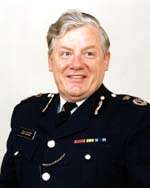
Constable Born: Qualifications: Police
career: Honours: Appointments: Secondments: Royal College of Defence Studies 1979 Review of Royal Swaziland Police 1981 Outside
interests: President, League of Friends, Chelmsford Training Centre Family: |

|
|
