|
|

|
|
|||
|
|
Essex Police Traffic Division |
||

 Back
to Full Support
Back
to Full Support|
|
|
|
|
|
|
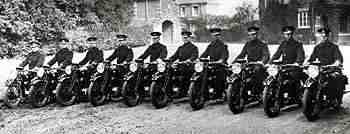
In 1931, the first motor cyclists were employed to patrol the roads. In the Southend on Sea Constabulary motor cycle combinations were used. |
||
|
In 1937 the Home Office decided to open regional police driving schools, Essex was one of the five chosen. At the time a Lagonda sports car was presented to the five schools by the inventor of a method of advanced driving, the Earl of Cottenham. The Essex Lagonda was used on the skid pan, and was eventually wrecked. After 60 years in operation the Essex Police Driving School is still teaching police officers and other emergency services the specialist skills they need. Currently there are 21 instructors based at the school.
|
|||
|
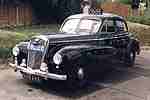
Most police cars were plain black with a sign on the roof, often with a warning bell. The Southend on Sea Constabulary had some exotic sports cars such as the S.S. Standard (which became the Jaguar) and the Hillman Aero Minx. In the 1960s their fleet contained Jaguars and a white Triumph TR4. Like the Essex County force they used mini vans for transporting police and dogs.
|
|
||
|
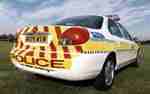
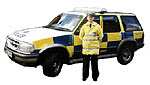
In the 1960s bells were replaced by sirens and by the 1970s coloured markings had appeared. The current style in use is the 'Battenburg' marking, blue and yellow squares with red markings on the rear and a force crest on the bonnet. These cars are only driven by officers in the Traffic Division. They can be easily identified not only by their cars but by the white tops to their caps. They receive more intense driver training than regular officers as they spend a high percentage of their time in hazardous road conditions. They are among the most highly trained and qualified drivers in the country. The QUICK QUIZ Page How
much can you remember?
|
|

|
|
